
There is a fairly widespread idea: once the page is published, the job is done. The website stays online, visitors arrive and it only needs attention when you want to change a photo or add a service.
Sometimes it works that way for a while. But a website also depends on a domain, hosting, certificates, forms, external services and, depending on the technology, components that need updating. The fact that it opens correctly today does not mean it is ready to keep doing so in six months.
Talking about maintenance is not about creating fear or justifying a monthly fee for its own sake. It is about explaining what tasks exist, who is responsible for them and what happens when something stops working.
What well-planned maintenance should include
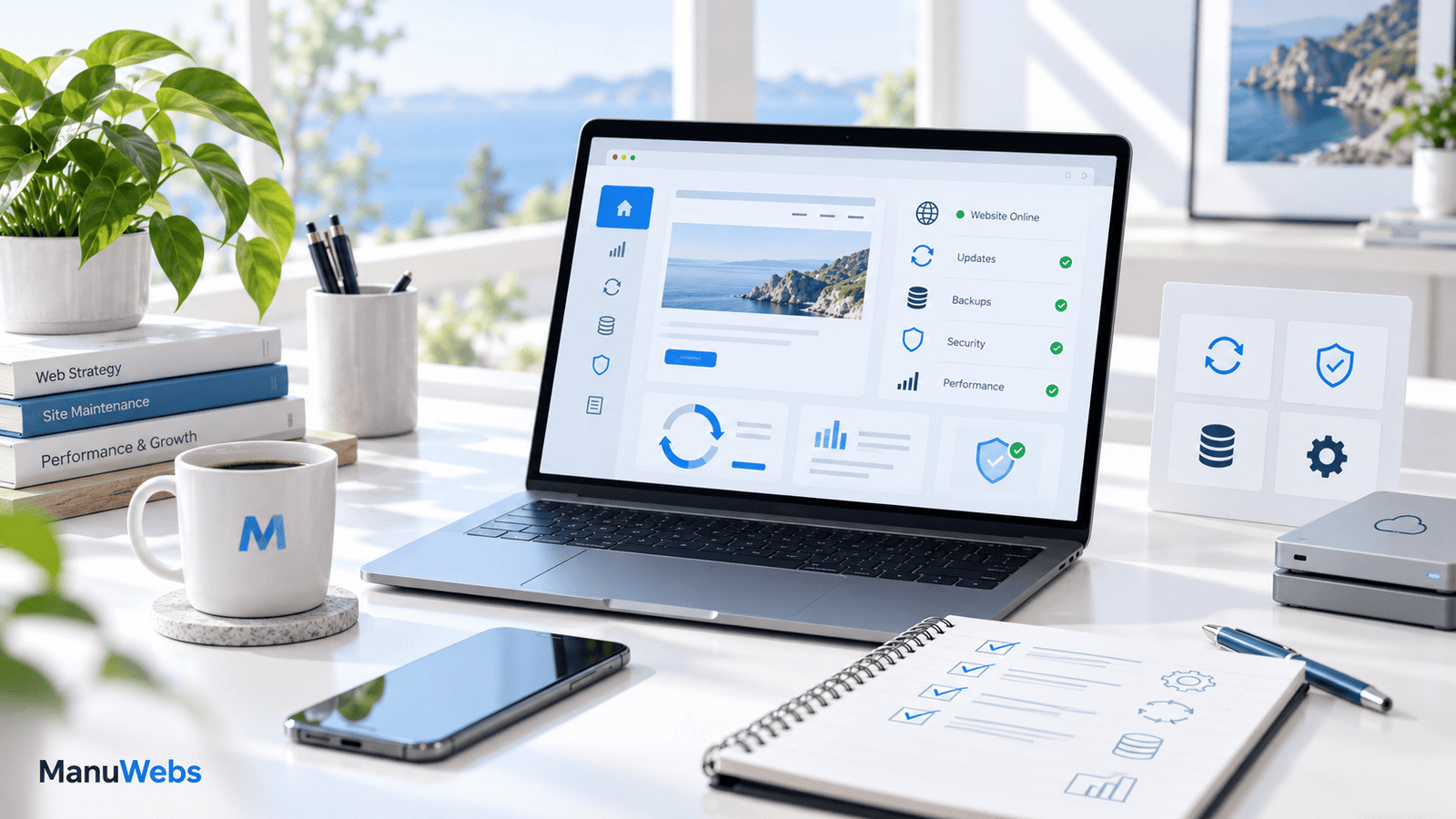
Not every website needs the same level of monitoring. A static business website has different requirements from a shop with payments, a private area or a WordPress installation with several plugins. Even so, some aspects are worth reviewing:
- Availability: checking that the website responds and identifying outages or significant errors.
- Updates: applying necessary system, library or plugin changes after assessing compatibility.
- Backups: establishing what is copied, how often, where it is stored and for how long.
- Restoration: verifying that a real procedure exists to recover the service; an untested backup does not provide the same reassurance.
- Security: reviewing permissions, access, forms, certificates and signs of unusual activity.
- Functionality: checking the elements that generate business, especially contact, bookings, purchases or requests.
- Periodic review: detecting relevant speed issues, broken links or display problems.
The key is not to pile tasks into a contract, but to prioritise those affecting the project.
Updating without checking can also cause problems
One piece of advice circulating online is that website maintenance simply means clicking “update all”. In some cases the process is straightforward; in others, an update can alter a design, break an integration or stop a form sending messages.
The procedure matters as much as the update
A responsible procedure includes a prior backup, assessment of significant changes and subsequent checks. When the project requires it, modifications are first tested in a separate environment.
What matters is not being able to say everything is up to date, but checking that the website still works as it should after the intervention.
Backups are not a minor detail
Imagine a small shop losing the orders recorded in its online store. Recovering the homepage is useful, but not enough if purchase data is missing.
The backup strategy should consider the type of information, how frequently it changes and the acceptable downtime. Backing up an informational website's files is not the same as backing up a database with daily activity.
Saving is not enough: restoration must be possible
It should also be clear who can restore, how access to backups is protected and the limits of the contracted service. Hosting may offer backups, but it is worth knowing their real scope rather than assuming it.
Domain, hosting and email: responsibilities must be clear
A website can be technically well developed and stop working because of an expired domain, an incorrect DNS change or a hosting problem. In some businesses, corporate email also depends on related configurations.
At handover, it is therefore important to know who is registered as the domain owner, who receives renewal notices, who manages hosting and who has access to essential services. Continuity should not depend on an unknown password or a single person who cannot be reached.
How often should a website be reviewed?
There is no universal frequency. A shop with transactions or a constantly changing portal needs more attention than a simple informational page. A sensible approach is to set a frequency proportionate to risk, technology and activity, and reinforce it after important changes.
Before accepting a maintenance service, ask what tasks it includes, what incidents are excluded, how interventions are communicated, what response times are agreed and who retains access. Paying every month does not guarantee quality; having a clear, verifiable process does add value.
Maintaining also means improving with sound judgement
Maintenance should not be confused with a permanent redesign. Sometimes it is better to update information, simplify a form or correct a mobile problem before completely changing the appearance. If you do not yet know what is wrong, see our five signs your website needs a technical review.
At ManuWebs, we believe a website should be maintainable without relying on improvisation. If you need to review your project's condition or clarify which maintenance tasks are really necessary, tell us about your website.
 Talk to Manuel on WhatsApp